
Close Alabama’s health coverage gap: Enact policies to save lives
By Debbie Smith, Cover Alabama campaign director (debbie@alarise.org) | Updated May 2026
No one should have to choose between going to the doctor and putting food on the table. But for more than a decade, Alabama lawmakers have turned down the opportunity to expand Medicaid to cover adults with low incomes. This choice has cost lives, weakened our healthcare system and left billions of federal dollars unused.
Alabama still urgently needs Medicaid expansion to help more people get care and to keep hospitals and clinics open across the state. While expansion remains essential, HR 1, the so-called One Big Beautiful Bill Act, has made financing more challenging and increased the need for sustainable solutions.
Federal policy changes are reshaping Medicaid financing
Alabama remains one of only 10 states yet to expand Medicaid. As a result, hundreds of thousands of Alabamians are caught in the state’s coverage gap, earning too much to qualify for Medicaid but too little to afford Marketplace insurance subsidies.
HR 1 eliminated a two‑year increase in the federal Medicaid match rate that would have brought Alabama hundreds of millions of dollars in exchange for expanding coverage. This incentive would have been enough to cover at least the first two years of Medicaid expansion. Without it, expansion may require identifying new, sustainable financing sources.
Provider tax changes create additional budget constraints
HR 1 also restricts how states can use provider taxes to finance Medicaid. Under the law, Alabama would be required to reduce provider tax collections gradually if it expanded Medicaid. This reduction could result in the loss of more than $100 million annually in healthcare revenue by 2032. Alabama Arise will continue making the case that lawmakers should not pit current Medicaid enrollees against people who need coverage but cannot afford it.
CMS data shows Marketplace consumers facing higher costs, selecting lower-quality coverage
Congress allowed enhanced Premium Tax Credits (ePTCs) for Marketplace coverage under the Affordable Care Act to expire on Dec. 31, 2025. It’s important to note that we will not know the full number of Alabamians who have lost Marketplace coverage until the Centers for Medicare and Medicaid Services (CMS) releases more data later this year. But preliminary data shows Alabamians are facing steep increases in their monthly premiums. As a result, at least 20,000 fewer Alabamians selected Marketplace plans in 2026. And for those who kept a Marketplace plan, many moved to lower-quality plans that will leave them with higher out-of-pocket costs when they need care.
Marketplace plans are tiered as bronze, silver, gold and platinum. Bronze plans have the lowest premiums but the highest deductibles and other cost-sharing requirements, while platinum plans have the highest premiums but lowest amount of cost sharing. CMS data shows a 58% increase in Alabamians enrolling in bronze Marketplace plans in 2026 compared to 2025. At the same time, data showed a 27% decrease in enrollment in silver plans, widely considered to be comparable to employer-sponsored plans in price and quality.
The growing affordability problem
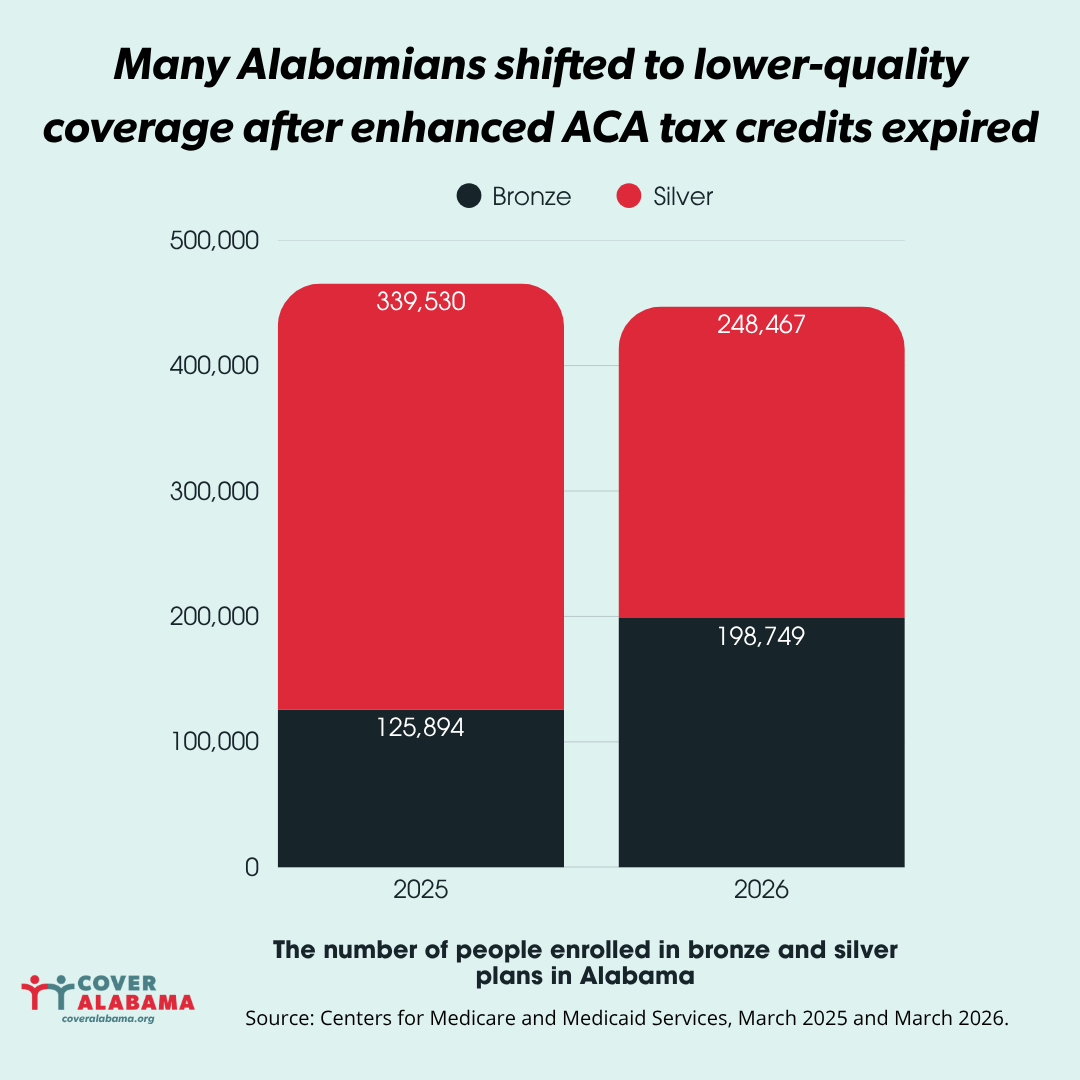
This trend is concerning because when people enroll in plans with higher out-of-pocket costs, they are less likely to use their insurance for preventive care. That can mean skipping important services like cancer screenings and routine checkups.
When preventive care is delayed or missed, health problems are more likely to be detected later when they are harder and more expensive to treat. This can lead to worse health outcomes and higher overall medical costs over time.
All of this points to a growing affordability problem in Alabama’s health coverage landscape. As Marketplace plans become harder to afford and more expensive to use, Medicaid expansion becomes even more important as a way to ensure people can get care without high out-of-pocket costs.
Persistent gaps in health coverage and outcomes
Nearly 155,000 adults remain stuck in Alabama’s coverage gap, and that number is expected to grow. Alabama also continues to rank poorly on key health outcomes, including maternal health and infant mortality. These harsh realities underscore the need for comprehensive coverage solutions.
Sustainable revenue options to fund Medicaid expansion
Even with the loss of the federal incentive, Alabama has multiple viable revenue options that can fully fund Medicaid expansion and strengthen the state’s long‑term fiscal stability. Earlier revenue analysis provides several pathways. These include:
1. Remove the state deduction for federal income taxes
Removing the state deduction for federal income tax (FIT) payments would generate $1.26 billion per year. Alabama is the only state that still allows a full FIT deduction. Eliminating it would modernize the tax code and generate enough revenue to:
Fund Medicaid expansion fully.
Pay the state share of costs for food assistance benefits under the Supplemental Nutrition Assistance Program (SNAP).
Eliminate the remaining state sales tax on groceries.
2. Remove the state deduction for FICA payroll taxes
Removing the state deduction for FICA payroll taxes would generate $387 million in revenue per year. Alabama is one of the only states offering a full FICA deduction. Ending it would broaden the tax base and provide stable, recurring revenue for Medicaid and other essential services.
3. Other revenue options
Increase the cigarette tax.
Adopt a tax on sugar‑sweetened beverages.
Close corporate tax loopholes, including adopting combined reporting.
Ensure large landowners pay a fairer share of property taxes.
These measures would diversify Alabama’s revenue streams and help the state meet long‑term health care needs.
Bottom line
Alabama can no longer afford the cost of inaction. Health coverage gaps are widening, health outcomes are worsening and federal policy changes have made delay even more expensive. The state has clear, achievable revenue options to fund Medicaid expansion sustainably and to strengthen our entire health care system. Medicaid expansion is the right choice for healthier families, stronger communities and a more resilient future for Alabama.