
‘Resilient communities begin with healthy people, period’
By Whit Sides, Cover Alabama storyteller, Alabama Arise
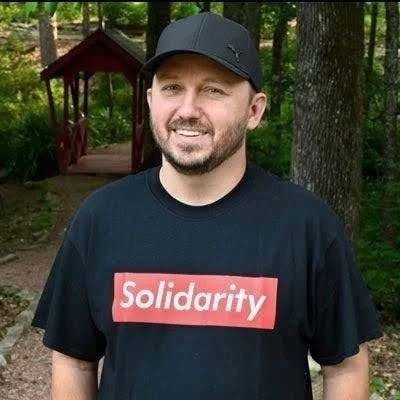
Warren Tidwell works as a disaster rebuilding and recovery organizer in rural communities like Parrish in Walker County and Camp Hill in Tallapoosa County. (Photo courtesy of the Alabama Center for Rural Organizing and Systemic Solutions)
Warren Alan Tidwell has spent years doing work that depends on trust. He does the slow, often unseen work of bringing people together across differences after an emergency.
“There’s very few men like me who aren’t a part of marginalized communities that have the ability to work across working-class lines, between white folks and Black folks, trans folks, queer folks, whatever,” Tidwell said. “And it’s built on 25 years of experience working in places like Ghana and Haiti, but most importantly, right here in rural Alabama.”
Warren is originally from Walker County, just west of Birmingham. But in recent years, he has centered his organizing work on disaster relief and recovery in Camp Hill in Tallapoosa County.
The work became more challenging after a powerful hail storm and flooding hit the small east Alabama town in March 2023. Since then, Warren has tarped roofs, rebuilt everything you can imagine and gathered resources as the town continues to recover.
“It’s not my job to lead, but it’s my job to help draft leaders, you know, build them up and get the hell out of their way,” he said.
Chronic pain that keeps getting worse
Warren said his approach as executive director of the Alabama Center for Rural Organizing and Systemic Solutions (ACROSS) focuses on helping communities grow their own leaders and solve problems together. Step one is getting people what they need. That’s tough to do without a grocery store or doctor in town.
And lately, the work has become even harder to keep up for personal reasons. Warren’s health is getting worse, and he can’t afford healthcare. He’s facing several health issues, often on his own and with no treatment. One of those is a hernia he has had for two years.
“It’s umbilical,” he said. “If it was inguinal, I’d have had to figure something out by now.”
Without health insurance, Warren has put off surgery and is trying to manage the pain day by day. But that keeps getting harder.
“If I keep on this rotation of NSAIDs and Tylenol, man, it’s just going to ruin my stomach and my liver,” he said.
Warren also recently has been facing headaches caused by trigeminal neuralgia. The pain wears on him.
“Chronic pain is what I’ve always feared, because I know it’s something I struggle with tremendously,” he said.
For Warren, that means not being there for a town that counts on him.
“My wife’s a schoolteacher, but her employer doesn’t offer [spousal coverage],” he said.
Warren went onto healthcare.gov to find coverage in the Marketplace, but he found no affordable plans available for him. He said his monthly premiums would’ve cost him nearly $800 out of pocket.
“Then the federal cut in tax subsidies cut me out of being able to afford it,” he said. “And because our nonprofit needs better funding, I can’t even keep the folks working for me in health coverage, least of all myself.”
Lack of healthcare limits workforce development
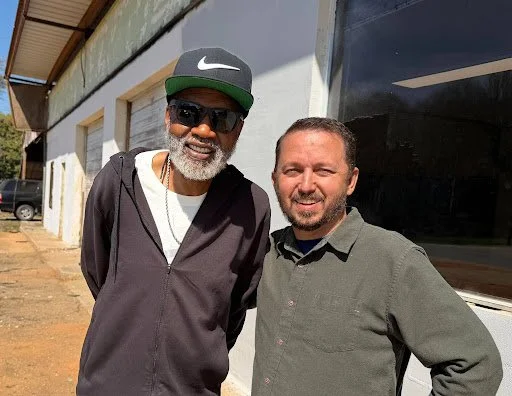
Warren Tidwell and Tommy “Pops” Sellers (left) worked together after a powerful 2023 hail storm in Tallapoosa County to set up a logistics network that still serves the people of Camp Hill. (Photo courtesy of Warren Tidwell)
Recent federal changes have made things even more difficult. Policies tied to the One Big Beautiful Bill Act have reduced access to affordable coverage for many people with low or middle incomes. That makes it even harder for people like Warren to get the care they need.
Warren spends every day investing in the people living in rural Alabama, and he said he wonders why the federal or state governments can’t do the same. He said lack of affordable health coverage isn’t just about being sick and skipping care for himself. It is also is limiting what organizations like his can do from a workforce development perspective.
“These are self-fulfilling prophecies,” he said. “If you can’t offer healthcare, people are going to have to sacrifice a lot just to be a part of that. Two people who work with me moved here from out of state to do this work. I don’t know if anyone would make that leap now.”
In rural places like Camp Hill, those struggles are easy to see — especially during disaster recovery. But as prices rise and wages stagnate for more Americans, Warren said rural Alabamians feel even more disenfranchised and alienated.
Lack of healthcare access affects entire communities. When people can’t get care, it weakens the systems meant to support everyone, Warren said.
“We have a number of seniors who are disabled on fixed incomes,” he said. “When prices go up, it affects every aspect of their life. They have no agency to take part in any kind of recovery.”
Investing in communities before it’s too late
Warren said he believes healthcare is the starting point for strong communities.
“Resilient communities begin with healthy people, period,” he said. “How can you help create opportunities and solve issues for other people when you’re trying to navigate the complexities of those issues yourself?”
For Warren and his organization, the stakes are rising. Without new funding to help cover costs (including health insurance for him and his staff), the work may not last much longer.
“If it gets worse with all of this health stuff, I mean, they’ll have to replace me,” he said. “If we’re not able to get the kind of funding we need by end of summer, we’re shutting down. I’ve got to take a job that I can get myself some insurance to take care of my health issues.”
What’s happening to Warren isn’t unusual. It’s the result of policy choices.
Alabama’s leaders often talk about investing in rural healthcare and economic development. But Warren’s situation shows a problem: Many of the people doing this work can’t afford to stay healthy enough to keep doing it.
Expanding Medicaid and renewing enhanced Premium Tax Credits for Marketplace coverage would be a good start. These investments in a healthier future would help Alabamians like Warren get the care they need. And they would make it easier for nonprofits like ACROSS to stay afloat.
In Camp Hill and rural communities across Alabama, the question is simple: Will policymakers invest in the people holding these communities together… before that work disappears?
About Alabama Arise and Cover Alabama
Whit Sides is the Cover Alabama storyteller for Alabama Arise, a statewide, member-led organization advancing public policies to improve the lives of Alabamians who are marginalized by poverty. Arise’s membership includes faith-based, community, nonprofit and civic groups, grassroots leaders and individuals from across Alabama. Email: whit@alarise.org.
Arise is a founding member of the Cover Alabama coalition. Cover Alabama is a nonpartisan alliance of advocacy groups, businesses, community organizations, consumer groups, health care providers and religious congregations advocating for Alabama to provide quality, affordable health coverage to its residents and implement a sustainable health care system.
Stories help to put a human face on the health care policy issues. By sharing your story, you help speak for people who may be facing issues just like yours.