
Mackenzie qualified for Medicaid care for 11 years. Her paperwork changed, but her disability didn’t.
By Whit Sides, Cover Alabama storyteller, Alabama Arise
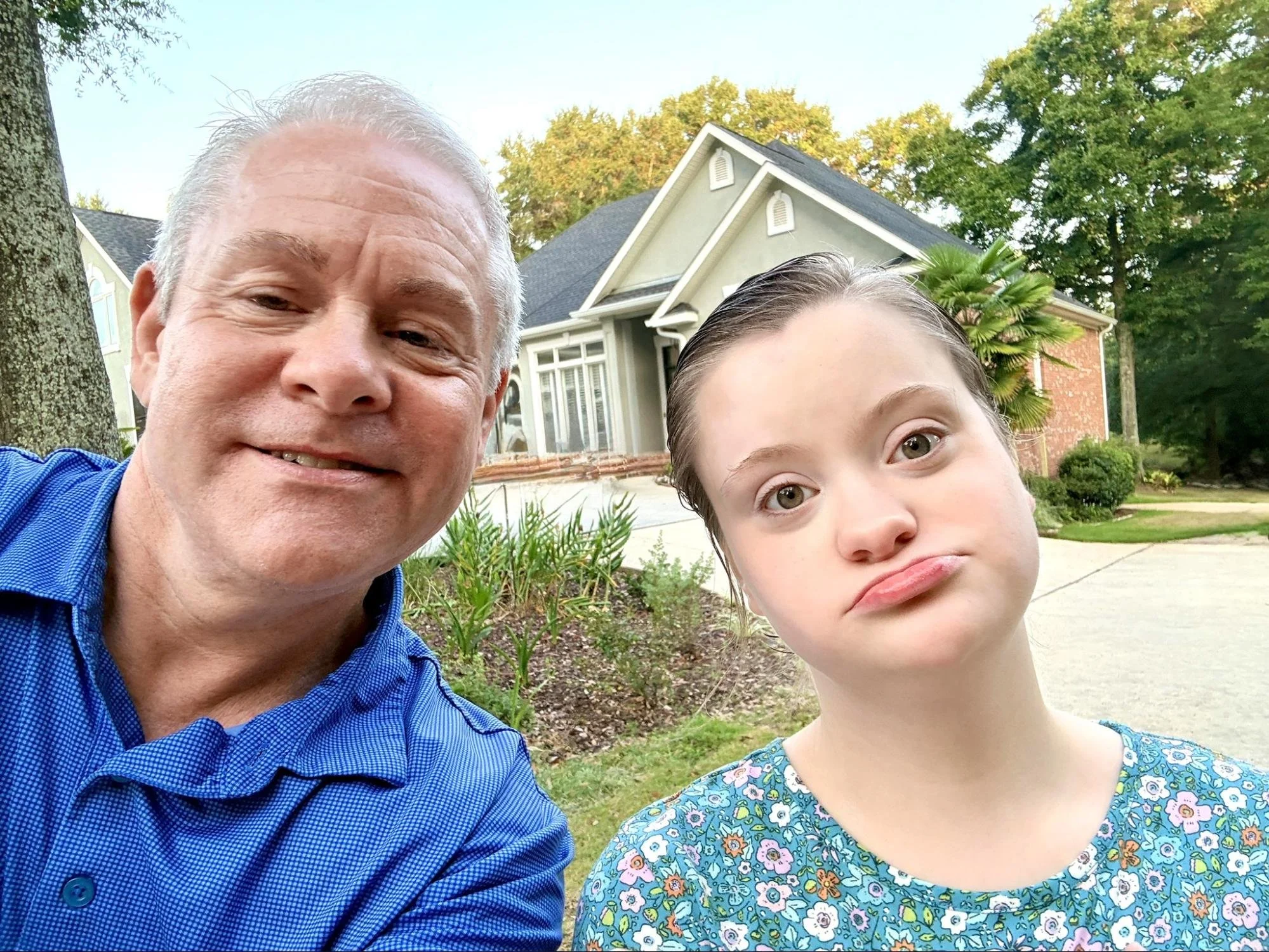
Jason Fisher and his daughter, Mackenzie, take a selfie outside their home in Fairhope as they wait for her school bus to arrive in August 2026. Jason has become an advocate for his family and other Alabamians who are at risk of losing Medicaid coverage for home- and community-based services. (Photo courtesy of Jason Fisher)
Jason Fisher had never seen the document the state used to decide his daughter no longer qualified for a Medicaid waiver. It appeared about nine months after the denial, among the evidence presented at a hearing where Jason represented himself.
On the form, he said, answers provided by his daughter Mackenzie’s pediatrician had been changed. The changes lowered her qualification score, leading to a denial of her Medicaid waiver that covered so many of her complicated needs.
“Who changed it?” Jason asked. “And what was the circumstance?”
Jason said officials first suggested he altered the form. But he had signed his section before the doctor completed the medical portion. He has a theory on who made the changes, but the fact remains: His family is left fighting for services that he thought were already promised.
“She’s 16 years old, and by all means fully disabled,” he said. “I don’t know of another definition.”
Mackenzie has distal 18q deletion syndrome, a rare chromosomal condition that can cause developmental and intellectual disabilities. Jason said she does not communicate verbally and depends on family and caregivers.
When Mackenzie was 2, her mother died unexpectedly at age 30. Jason became a widowed father raising a disabled child on his own. For the next 11 years, Alabama Medicaid’s Elderly and Disabled Waiver helped him keep working while Mackenzie received care at their home in Fairhope, located east of Mobile Bay.
Then last summer, Jason received notice that Mackenzie no longer qualified.
What the waiver made possible
Medicaid’s Elderly and Disabled Waiver covers home- and community-based services for people who otherwise would require nursing facility care. Those services can include case management, personal care, homemaker services, respite care and other support.
Mackenzie’s needs have not changed, Jason said. But even after he questioned the altered form, the standards used to evaluate her seemed to keep shifting.
“They are trying to use the documents and the forms and qualification scores as a malleable instrument,” he said. “They can interpret it however they want.”
Jason’s family is not alone. Earlier this month, Alabama Arise shared the story of Angel Garrett, a DeKalb County writer and disability advocate whose waiver renewal also was denied even though her diagnosis had not changed. Angel’s waiver helped her receive groceries, prepare food and remain safe at home after her father died.
“Absolutely nothing changed in my diagnosis. I didn’t all of a sudden wake up one morning without my disability,” she said.
Angel’s experience reflects what many disability advocates are hearing from people across Alabama. Waiver denials and service interruptions are forcing many Alabamians with disabilities into lengthy appeals while they try to hold on to the support they need to live safely and independently. Angel’s Medicaid waiver offered her the freedom that her schizocephaly diagnosis denied her.
“It wasn’t until my dad died that I realized how much he helped me be independent. As well as how much I will need assistance as I age. I am already experiencing loss of some of my independence,” she said.
Families facing the same questions
Angel and Mackenzie rely on different services, but both faced waiver renewal denials even though their disabilities and day-to-day support needs never changed.
State agencies denied using targets or quotas to reduce enrollment, according to recent reporting by Lagniappe in Mobile. Jason said his family’s battle came shortly after the U.S. Department of Justice (DOJ) raised concerns in federal filings over Alabama’s support for disabled children.
In January 2025, the DOJ found that Alabama’s long-term care system unnecessarily segregates some children with physical disabilities in institutions and places others at serious risk of institutionalization. The department said the state was violating the Americans with Disabilities Act by failing to provide services those children needed to live in their homes and communities.
For Jason, these questions are urgent: How many waiver recipients have had their coverage terminated? Where do they live? Why were they denied?
Jason said he wants the state to release aggregate information that could help answer those questions without identifying individual families.
‘Forcing families to relive the trauma’
Mackenzie has continued receiving benefits while Jason appeals, but keeping coverage during the process has not erased the harm, he said.
Parents still have to decipher notices, meet appeal deadlines and learn an administrative system while working and caring for their children. Some hire attorneys. Most can’t afford it.
“They don’t have the money or the mental willpower because they’re dealing with disabled kids,” Jason said. “It sucks the life out of you some days.”
After his wife died, Jason said, the waiver’s respite services helped him avoid burnout and meet his responsibilities at work and at home. Private insurance could help pay for Mackenzie’s medical care. It could not pay for another person being there when Jason and Mackenzie needed downtime.
“I needed the respite hours because, as a single parent, when my family wasn’t there, I was getting burned out,” he said. “It’s really, really hard. It’s very easy to fall short of your work responsibilities when you have so much on the line with your child at home.”
The process has forced him to return to some of the hardest years of his life.
“They are forcing families to relive the trauma of having a child that’s disabled, because you have to prove — all over again — that they’re disabled,” he said.
Standing up for the next family
Jason has spent 11 years learning a system most parents never expect to navigate. He knows other families may not have the same time or resources to deal with the administrative labyrinth. That is why he said he refuses to treat Mackenzie’s case as only his family’s problem.
“Me giving up is tantamount to letting other people suffer because I didn’t want to stand up,” he said. “If people don’t take a stand when they know they’re right, then the ball never stops rolling. It’ll roll right over others.”
Jason said he wants families facing unexplained waiver denials to know they are not alone. He also asked Alabama officials to explain how these decisions are being made and whether the same standards are being applied to every family.
Home- and community-based services provided by Medicaid waivers are meant to help disabled people remain with their families and participate in their communities. Jason said families who lose that support may decide they cannot build a future in Alabama.
“You’re asking people to live in a state that doesn’t support them,” he said. “If they have the ability to leave, and they have skills and capabilities of contributing to society, you’re going to lose that.”
Jason said he would accept the state’s decision if the facts supported it. Right now, he doesn’t believe they do.
“I won’t fight it if they’re right,” he said. “But they’re absolutely wrong. If we want to know the truth, we have to be able to marshal up our forces and speak with one voice.”
About Alabama Arise and Cover Alabama
Whit Sides is the Cover Alabama storyteller for Alabama Arise, a statewide, member-led organization advancing public policies to improve the lives of Alabamians who are marginalized by poverty. Arise’s membership includes faith-based, community, nonprofit and civic groups, grassroots leaders and individuals from across Alabama. Email: whit@alarise.org.
Arise is a founding member of the Cover Alabama coalition. Cover Alabama is a nonpartisan alliance of advocacy groups, businesses, community organizations, consumer groups, health care providers and religious congregations advocating for Alabama to provide quality, affordable health coverage to its residents and implement a sustainable health care system.
Stories help to put a human face on the health care policy issues. By sharing your story, you help speak for people who may be facing issues just like yours.