
Rev. Shane Isner advocates for affordable healthcare for all Alabamians – including his own family
By Whit Sides, Cover Alabama storyteller, Alabama Arise
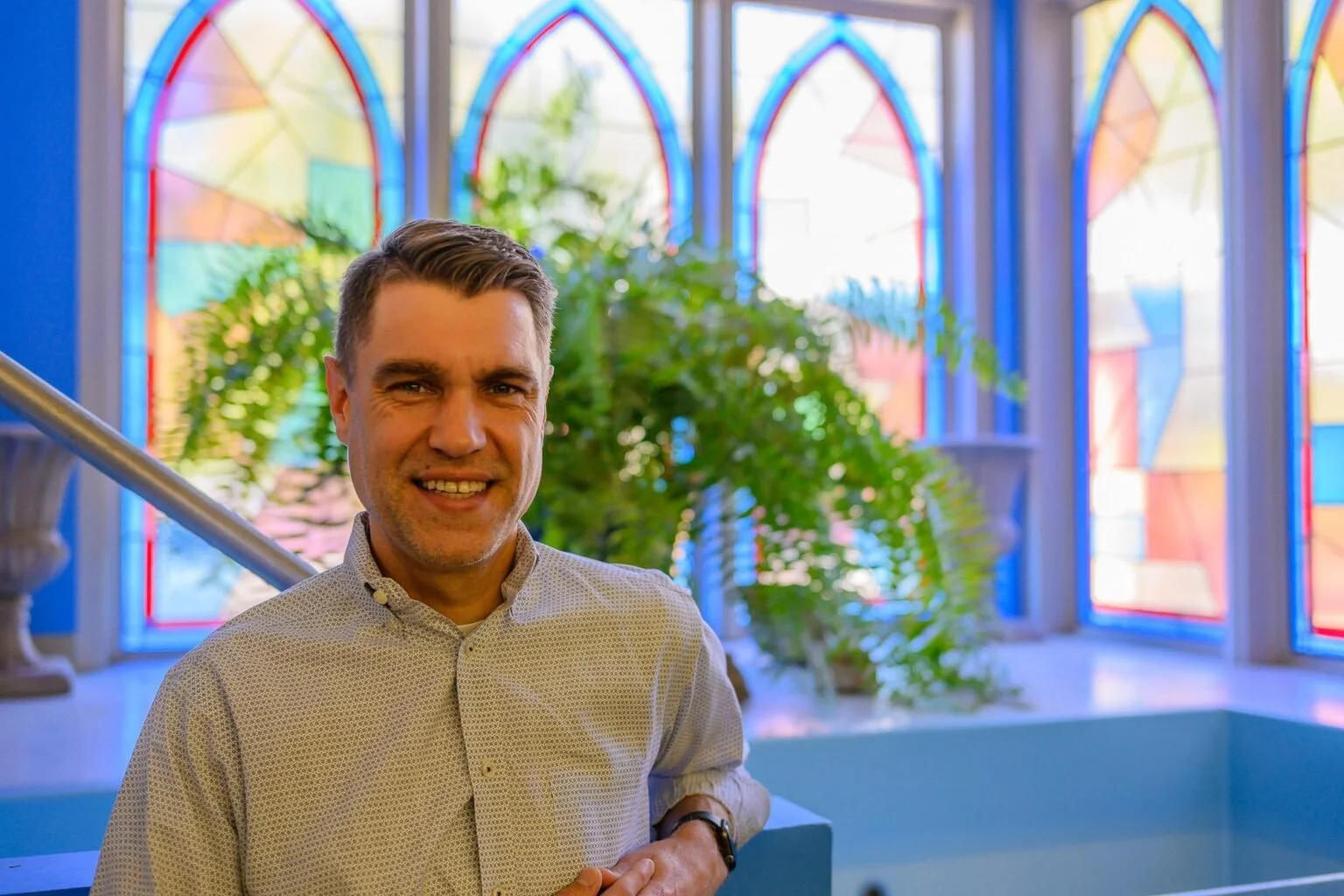
Rev. Shane Isner stands in the sanctuary of First Christian Church in Montgomery in October 2025. As a pastor, Shane said he believes ensuring affordable healthcare for all Alabamians is a moral imperative. (Photo by Whit Sides)
Rev. Shane Isner was a long way from Alabama when he started his journey as an ordained pastor 20 years ago. He was born in Colorado and went on to serve churches in Lexington, Ky., and Minneapolis.
When he got the opportunity to lead the First Christian Church in Montgomery in 2016, Shane and his wife, Tabitha, answered the call. But soon after moving to Alabama, he had to reconcile several things. One of those was how to make his new budget work to fill all of his family’s needs.
Shane’s education included a focus on public theology, so he said he always felt a calling to advocate on behalf of others. That has included support for LGBTQ+ equality, death penalty reform, people experiencing homelessness and neighbors needing access to affordable healthcare. He continues to center his work around social justice and racial reconciliation, taking time to listen to the stories of community members he works with every day.
As someone who centers his work on bridging gaps for those in need, Shane soon realized he also had his own story to share about how public policy has helped his family.
“I first started as an ordained pastor about 20 years ago. There was originally a healthcare plan offered, but it folded,” he said. “After a while, they couldn’t afford to keep it going, which was terrifying for a lot of pastors, because a number of us, you know, they’re serving rural churches or they’re serving small-town churches. They may be the only breadwinner in their family.”
A struggle to make the math work
When Congress enacted the Affordable Care Act (ACA) in 2010, Shane said, it offered a way for faith leaders and other people who didn’t receive health insurance from their church home to find coverage.
“My church is my employer, but as a pastor, my denomination is kind of my professional association. If that’s not who offers our health coverage, where are we going to go? It’s a big concern,” he said. “The ACA became the lifeline for a ton of pastors in my denomination. … I presume it’s similar for other faith traditions.”
Shane said the pay structure for most pastors he knows leaves little wiggle room to afford full-price private health insurance. The income-based premium support available for ACA Marketplace plans helps families like his afford healthcare each month. Shane and his family are among more than 455,000 Alabamians who have selected a Marketplace health plan for 2026.
“Ideally, every church pays a pastor salary, housing and benefits. And benefits often include retirement and healthcare,” he said. “Some churches can’t afford that, and so they give pastors a salary package. … They say, ‘We’ll give you $50,000 or $60,000, and that has to be your salary, your housing, your retirement plan and your healthcare.’ And so as healthcare costs rise, that means our salaries have to fall as a result.”
The math simply doesn’t work for some ministers. Shane said several friends have left the ministry for a corporate job because they couldn’t afford to stick around.
“The common refrain is you just hope that your spouse has healthcare coverage through their job,” he said. “Hope that your church covers benefits along with salary. Hope that you’re young enough and don’t get sick, or just hope and pray. And alas, sometimes that doesn’t work.”
‘Thank God for the ACA’
Pastors’ pay structure often makes it hard to predict household budgets, spending or what supports will be available in the coming year. A miscalculation can result in a stiff financial penalty.
“As a pastor, I don’t receive health insurance through my job. We always just buy our plans through healthcare.gov,” Shane said. “What makes it more complicated is all the things up in the air: my wife’s income, even though she’s not working right now, and how much of our housing allowance we use toward our home. If either goes up or down in a given year, we must pay it back either in health premiums or taxes.”
Shane said the uncertainty has led to some surprises in the past. One year, his family had to pay back close to $2,500 in taxes because he couldn’t predict accurately enough what his taxable income would be.

Rev. Shane Isner stands inside the sanctuary at the First Christian Church in Montgomery in October 2025. Like many pastors, Shane buys health coverage for his family through the Marketplace created under the Affordable Care Act. (Photo by Whit Sides)
Earlier in his career, Shane’s family received coverage through his wife’s employer. But when they moved from Minneapolis to Montgomery, she had to leave her job without a new one lined up. That’s when they first bought coverage on the Marketplace.
When Shane’s wife found work in Alabama, they used her employer-provided coverage. But when her job ended in April 2025, they needed healthcare.gov again.
“I purchased health insurance on the exchange for our family,” Shane said. “My son was adopted from foster care, so luckily, he is still covered through Medicaid. That is a gift. For us, we sacrifice, but he doesn’t. Thank God for the ACA, right?”
Enhanced credit expiration brings higher costs, downgrade in coverage
Congress enacted enhanced Premium Tax Credits (ePTCs) for ACA Marketplace plans in 2021 to help make coverage more affordable. Tens of millions of Americans benefited, including many Alabamians who obtained coverage they previously could not afford. The number of people caught in Alabama’s health coverage gap – earning too much to qualify for Medicaid but too little to afford private coverage – decreased dramatically as a result, falling from more than 340,000 to around 200,000.
But Congress allowed ePTCs to expire in December 2025, making healthcare more expensive for tens of millions of Americans. Many people had to switch to insurance plans that covered fewer services or required them to pay more out of pocket. Others had to drop coverage entirely.
Some Marketplace consumers received notifications late last year about steep increases in their monthly bill. When he didn’t, Shane began looking for answers. He read a state-by-state breakdown of what costs could be passed on to consumers. He also used an online calculator to estimate premium increases after ePTCs expired. Shane determined the estimated premium increase for his wife and him would be 18.1%.
That increase for their existing plan would have been too burdensome, he said. So Shane and his wife decided to enroll in a lower-cost and less comprehensive bronze-tier plan through BlueCross BlueShield.
Shane’s family applied using healthcare.gov, in the hope that they could be eligible for subsidies in 2026. He said they were fortunate enough to find an option that worked for their budget.
“We’re under the income threshold and receive premium supports,” he said. “That’s only because of my wife’s lack of income. If she’s able to earn money this year, and we hope she is, we’re probably going to have to pay a higher amount.”
‘Maybe we’ll have better coverage soon’
Beyond his personal experience, Shane said, rising costs cause him real concern as a faith leader, especially for older adults. Many Americans aged 50 and older are facing crushing healthcare cost increases because Congress failed to renew the ePTCs.
Shane said he worries some of his fellow pastors, especially those in the 55 to 64 age range, are facing even heftier costs without the enhanced credits. Compared to a typical pastor’s salary, which is usually $45,000 to $50,000 a year, having to cover healthcare costs like that could be “catastrophic,” he said.
While his wife seeks a new job, Shane said he is grateful not to face a gap in health coverage. Still, some things are a little “wonky,” as he puts it, because his family had to change to a less comprehensive plan.
“I went to the doctor for an appointment I set up when I had better insurance. I walked in and found out we’re no longer covered,” he said. “We’re on the bronze plan, and I guess we’ll be OK, but I’m not looking forward to the uncertainty. Maybe we’ll have better coverage soon. It’s hard to pay out of pocket.”
Environment of fear means fewer resources, less funding for healthcare
Shane’s concerns about lack of access to affordable health coverage are extensive. But he emphasized two immediate concerns for churches and communities across Alabama.
First, many local churches are experiencing rising costs and shrinking budgets, he said. As many churches face declining enrollment, they also often see lower giving as their congregants struggle with rising healthcare prices, inflation and medical debt. This means fewer resources for ministries that offer tangible support to the community, such as food distribution, support for unhoused neighbors and benevolent funds to support church members facing urgent needs.
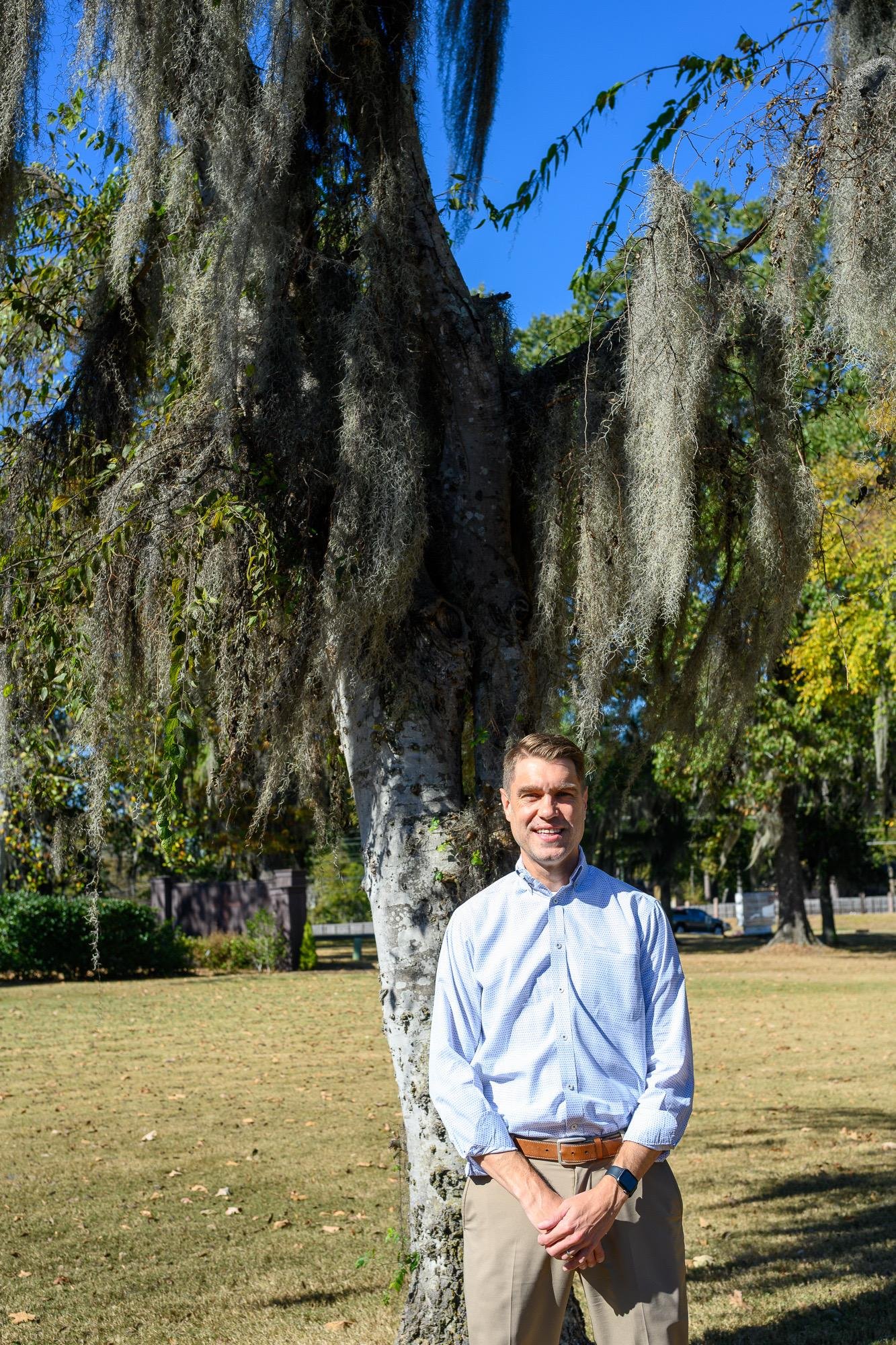
Rev. Shane Isner stands outside the First Christian Church in Montgomery in October 2025. Shane said his faith calls him to advocate for equity for marginalized people, and he said ensuring affordable healthcare for all Alabamians should be a top priority for state leaders.
Shane also said many of his colleagues who lead Hindu and Muslim congregations are seeing their members leave Alabama or even the country. Many highly skilled workers, including some working in healthcare, are afraid of losing sponsorship for H1B visas or of putting their families at risk regardless of status by remaining here, he said. That means Alabama has fewer skilled doctors and specialists for big cities and surrounding rural communities that are already underserved.
“We are hurting ourselves, even though welcoming people to our communities – we know it’s good for us,” he said. “We know it helps our healthcare system stay afloat. We know it helps our local tax base at least have a chance. And we’re kicking them out because we just can’t help ourselves but find a scapegoat, and we’re just addicted to scapegoating.”
A moral calling to help neighbors in need
Exclusionary immigration policies and funding cuts for healthcare and other vital human services are connected, Shane said. Undocumented immigrant workers subsidize our country’s healthcare system – as well as retirement and disability programs – with more than $1.2 billion annually in federal, state and local taxes. That is true even though they cannot benefit from those same services.
Affordable healthcare is a greater challenge in Alabama than in most other states. That’s because Alabama is one of only 10 states yet to expand Medicaid to cover adults with low incomes. Shane said he believes it is both shortsighted and a moral failure to blame people who have come to Alabama from other countries for the problems that only people passing laws in Montgomery and Washington, D.C., can fix.
“That’s kind of the story of the Christian church,” he said. “Not enough people tell this story. The reason I have a job is that there was a guy 2,000 years ago who was telling his community and his government to help people care for one another, help the poor, release the captives, lift the oppressed, set the oppressed free. I mean, that’s the first sermon Jesus gives in the Gospel of Luke. And it scared the people in power so much, and they scapegoated him for it. And here we are again.”
Shane said he believes relieving hunger and ensuring affordable healthcare and housing for those in need should be top priorities for Alabama’s leaders. And blaming immigrants for lack of investment in those supports is not the way forward, he said – whether thousands of years ago or right now.
About Alabama Arise and Cover Alabama
Whit Sides is the Cover Alabama storyteller for Alabama Arise, a statewide, member-led organization advancing public policies to improve the lives of Alabamians who are marginalized by poverty. Arise’s membership includes faith-based, community, nonprofit and civic groups, grassroots leaders and individuals from across Alabama. Email: whit@alarise.org.
Arise is a founding member of the Cover Alabama coalition. Cover Alabama is a nonpartisan alliance of advocacy groups, businesses, community organizations, consumer groups, health care providers and religious congregations advocating for Alabama to provide quality, affordable health coverage to its residents and implement a sustainable health care system.
Stories help to put a human face on the health care policy issues. By sharing your story, you help speak for people who may be facing issues just like yours.